When it makes sense
- customers ask ChatGPT about companies like yours and you are not there
- Google AI Overviews cite competitors for your key queries
- you do not know what AI assistants say about your offer

More and more customers start choosing a company by asking an AI assistant or reading Google's AI summary. We check what these tools say about you, whom they recommend instead of you and which sources they use — then we put in order everything AI builds its picture of your company from.
The monthly plans are not just monitoring. Every month we measure, analyse the data, implement changes on the website and in the sources AI draws from, and expand content — and the report shows what we did and what it changed. The same terms for every plan: open-ended contract with 30 days' notice, no penalties; content, data and access remain yours.
PLN 0 no obligations
First step: whether and how AI talks about your company.
PLN 1,800 net / month
Monthly work on visibility in ChatGPT and Google: measurement, analysis, implementation.
PLN 3,000 net / month
Building topic clusters and working on everything AI builds your company's picture from.
Multilingual websites, stores with thousands of products, brand groups or companies with many locations — there is more work there and the scope has to be agreed individually: the number of tracked questions and markets, the pace of content and cluster production, work on profiles in several countries, cooperation with your marketing team or SEO agency. We start the same way, with the free audit, and then prepare an offer with a fixed monthly price and a described scope — no hourly billing.
Generative engine optimization sounds like a promise of a ranking position, but AI assistants have no rankings. They answer questions by assembling a picture of your company from what they find: your website, your Google Business Profile, reviews, industry directories and the articles that cite them. That is why we work on two things at once: reliable measurement (the same questions, repeated runs, “x out of N” numbers) and tidying up every place AI draws facts from.
The first step is free: within 3 business days you receive a PDF answering whether and how AI talks about your company — no website access, no obligations.
Google's AI summary sits above the regular results and cites pages that are indexed, fast and answer the question directly. ChatGPT and Perplexity reach for the same sources: the company website, the Google Business Profile, reviews, industry directories. That is why classic SEO (technical work, content, internal linking, local profile) is the foundation of AI visibility, not its competitor.
The difference lies in two places: in measurement (not a position, but the "x out of N" questions in which the company is mentioned, across three assistants and AI Overviews) and in the sources outside the website that AI reads more often than people do: profiles, directories, structured data, the llms.txt file. We work on both layers at once, in one monthly rhythm and one report.
The first is Google: AI Overviews and AI Mode, the AI summaries above regular results. For each of your queries we check whether such a summary appears, which pages it cites and whether you are among them. The second is the assistants — ChatGPT, Gemini, Perplexity — which we ask the way a customer does: “which company…”, “how much does…”, “can you recommend someone in…”. The third is the fact base: your website, Google Business Profile, industry directories and review sites — the places assistants assemble their answer from.
AI visibility rarely improves through a single change. What usually works is consistency: the same data everywhere, clear answers to customer questions on the website, transparent information (starting prices, scope, location) and content that assistants find worth citing.
AI answers change from day to day and from query to query. That is why we ask the same set of questions repeatedly and report presence as “x out of N” — for example “the company appeared in 4 out of 9 answers”. The question set stays fixed between measurements: that is what makes an honest “before” and “after”.
We do not force names into questions. If an assistant recommends nobody, that is an important result too. Every report has a “Scope and methods” section and small samples are flagged — you cannot draw conclusions from two answers, so we do not.
Every month follows the same cycle: measurement with the same question set, analysis of the results together with Search Console and GA4 data, a change plan, implementation and a report. The analysis answers concrete questions: in which questions did we lose or gain presence, whom does AI cite instead of you and from which source, which Google queries now show an AI summary and are you cited in it.
The analysis turns into work: rewriting a service page so it answers the question about price and scope; new content closing a gap in the topic cluster; fixing facts in the business profile and directories; structured data and llms.txt; expanding regional pages. Everything is published after your approval, and the report shows the list of changes next to the numbers — so you can see the link between the work and the result.
If you prefer to start with a one-off clean-up and decide on ongoing cooperation later, we split the implementation into three modules. Each has a fixed price and a described scope; they can be ordered separately, and a monthly plan is the natural next step after implementation.
Assistants do not guess: they cite pages, business profiles and directories. If your website does not answer the question about price or scope directly, AI will cite a competitor who does. If your Google Business Profile says something different from your website, AI will pick one version — not necessarily the true one.
So we align the facts (name, address, phone, years in business, ratings, scope of services) everywhere, add structured data and an llms.txt file, expand service pages with answers to real customer questions and — where it makes sense — create content that assistants find worth citing. No tricks: no bought mentions, no flooding the web with text.
At a clinic that is the local leader in Google, AI Overviews for nationwide questions about procedure prices cited only facilities with public price lists — the clinic had a price list, but not on its procedure pages. The same measurement revealed a mismatch in the doctor's years of experience between the website and an external profile, and a review widget showing an older rating than Google Business Profile.
At a law firm the main brake turned out to be more than a hundred theme demo pages still present in the index — noise that blurs the picture of the company for AI. At another practice the assistant recommended it for city questions but pointed to competitors 100 km away for regional ones. Findings like these are concrete and mostly fixable within a few weeks.
We do not promise that ChatGPT will start recommending your company by a given date — nobody controls assistants' answers, and anyone promising “guaranteed AI presence” is selling something that does not exist. We promise measurement that can be repeated and work on everything we can genuinely influence.
We do not publish market figures without a source and we do not scare you with “how much this costs you every month”. The report shows the state and the priorities; the decision on next steps is yours.
First we check where you stand. Only the measurement decides whether and how far it is worth going.
You send the website address and what your customers ask about (services, city).
8–10 of your customers' questions put to ChatGPT three times, AI Overviews for your key queries, a list of whom AI recommends instead of you. PDF within 3 business days, no website access needed.
We discuss the findings and propose a scope: Starter, Full or starter modules. If you already have an SEO agency — we work alongside it or take over its scope.
Measurement on a fixed question set, changes on the website and in the sources AI cites, content for customer questions — always after your approval. Medical content is verified by the clinic's specialist before publication.
A monthly report with the trend and raw AI answers on request. Open-ended contract with 30 days' notice.
Excerpts from a report prepared for a client — published with their consent.
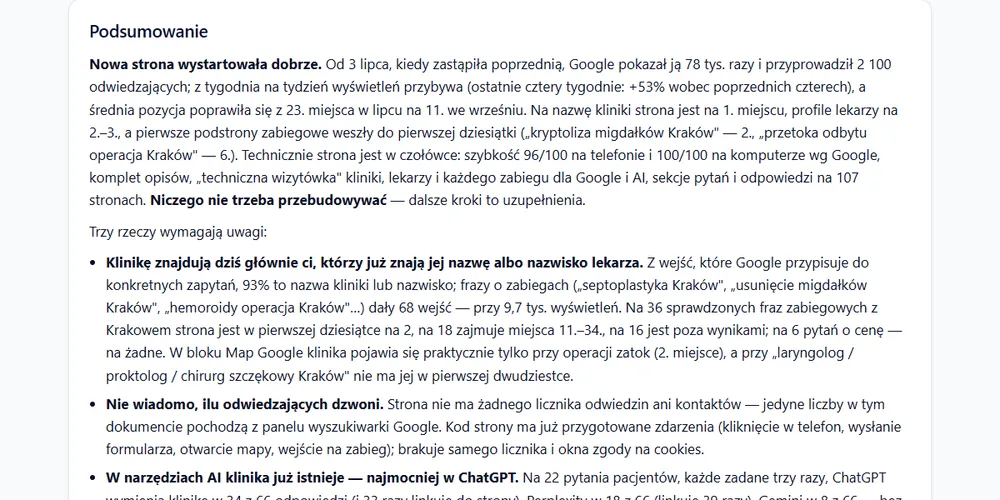
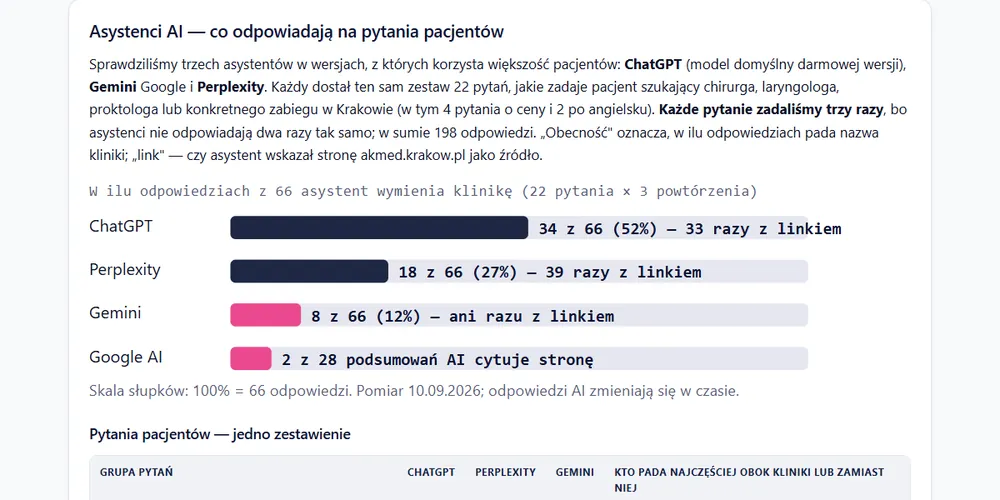
SEO competes for a place on the results list. AI assistants have no list — they assemble one answer from several sources. What matters is not a position but whether you are one of the cited sources and whether the facts about you are consistent everywhere AI draws from. Solid technical SEO still helps, because AI Overviews and ChatGPT's web search rely on search-engine indexes.
Not in the sense of a guaranteed position. What can be done is making sure that everywhere assistants draw information from, the facts are complete and consistent and the customer questions are answered — and measuring regularly whether it works. That is exactly what we do.
Website and business-profile changes reach the index within days or weeks, but assistants also use their own, more slowly refreshed sources. We usually see the first differences in the “after” measurement after 4–8 weeks, which is why monitoring makes sense as continuous work rather than a one-off action.
No. The audit is done from the outside: we ask the assistants, check AI Overviews and compare public sources. Access (Search Console, business profile, website) becomes useful only at the implementation stage.
A simple text file on your website that describes the company and points to the most important pages in a form convenient for language models. It is cheap and harmless, but it does not replace consistent facts on the website — we treat it as one element of the foundation, not a magic switch.
Service businesses customers ask assistants about before getting in touch: clinics and practices, law firms, accounting offices, B2B companies with complex offers, specialist stores. If “can you recommend someone…” is a common question in your industry, it is worth knowing whom AI recommends.
Two options: we work alongside your agency (we handle measurement and AI-related changes, it keeps its scope) or we take over its scope entirely, because SEO and AI visibility are one job. You decide after the first measurement.
We prepare the content, but the clinic's specialist verifies it before publication — a condition, not an option. We know the Polish rules on informing about healthcare services (the Medical Activity Act, the Code of Medical Ethics and the Supreme Medical Council's rules): information about the scope of services, without advertising features and without promised outcomes.
A website, application or hosting setup rarely exists in isolation. Related services help move from one problem to a fuller view of the project.
Analysis of user paths, indexing, speed, content and places that limit conversion.
Read more →GA4, Search Console, landing pages, CTA events and a data-informed growth backlog.
Read more →WordPress, headless and static-first websites. From small business sites to larger company services.
Read more →Updates, daily backups, 24/7 uptime, SSL and domain monitoring plus work hours — transparent plans from PLN 300 net per month.
Read more →